The Ship of Theseus: From Wooden Boat to Space Station
15 years of personal infrastructure evolution, empirical timeline evidence, and recursive system cartography.
The 5 Planks of System Transformation (2010 to 2026)
9d367da0).e25021c7).Investigation Theme: The Ship of Theseus paradox applied to 15 years of personal developer tooling.
Core Thesis: The vessel transformed from a wooden boat into an autonomous space station, but remains the same system because Theseus himself carved and directed every substitution.
Verifiable Subprocess Proofs: 27/27 assertions OK across L0-L5 layers (
bin/mp-panoramic prove-subprocess).Teleprompter Materials: Spoken Rundown · Native Textream Script
Adversarial Briefing: Executive Briefing Dossier & Objections
Act 1: The Wooden Plank and the Ancient Paradox
In Greek mythology, there is an ancient paradox called the Ship of Theseus. As the wooden planks of Theseus's ship began to rot across decades of voyaging, the sailors replaced them one by one. Eventually, not a single original piece of wood remained. Philosophers have argued for centuries: was it still the same ship?
Today on Studio Workbench, I explore that question from behind this desk. Because this morning, I watched our autonomous media pipeline take a fresh twenty-eight-minute recording, hydrate it from cloud storage, extract ephemeral audio, transcribe speech locally on Apple Silicon in one hundred and three seconds, and queue it for publication with zero permanent disk waste.
And as I watched it work, I realized: this pipeline is a direct descendant of a system I have been trying to build for fifteen years. It feels like watching a wooden boat turn into a space station. And there is one key difference from the myth: in this room, Theseus himself was the one cutting and fitting every replacement plank.
Act 2: The Original Aspiration (2009 to 2022)
To understand how we arrived at an autonomous pipeline, you have to look at the potter's marks left in the clay across different machines, operating systems, and git histories over fifteen years:
- February 2011: In the Chicago Code Camp repository, commit
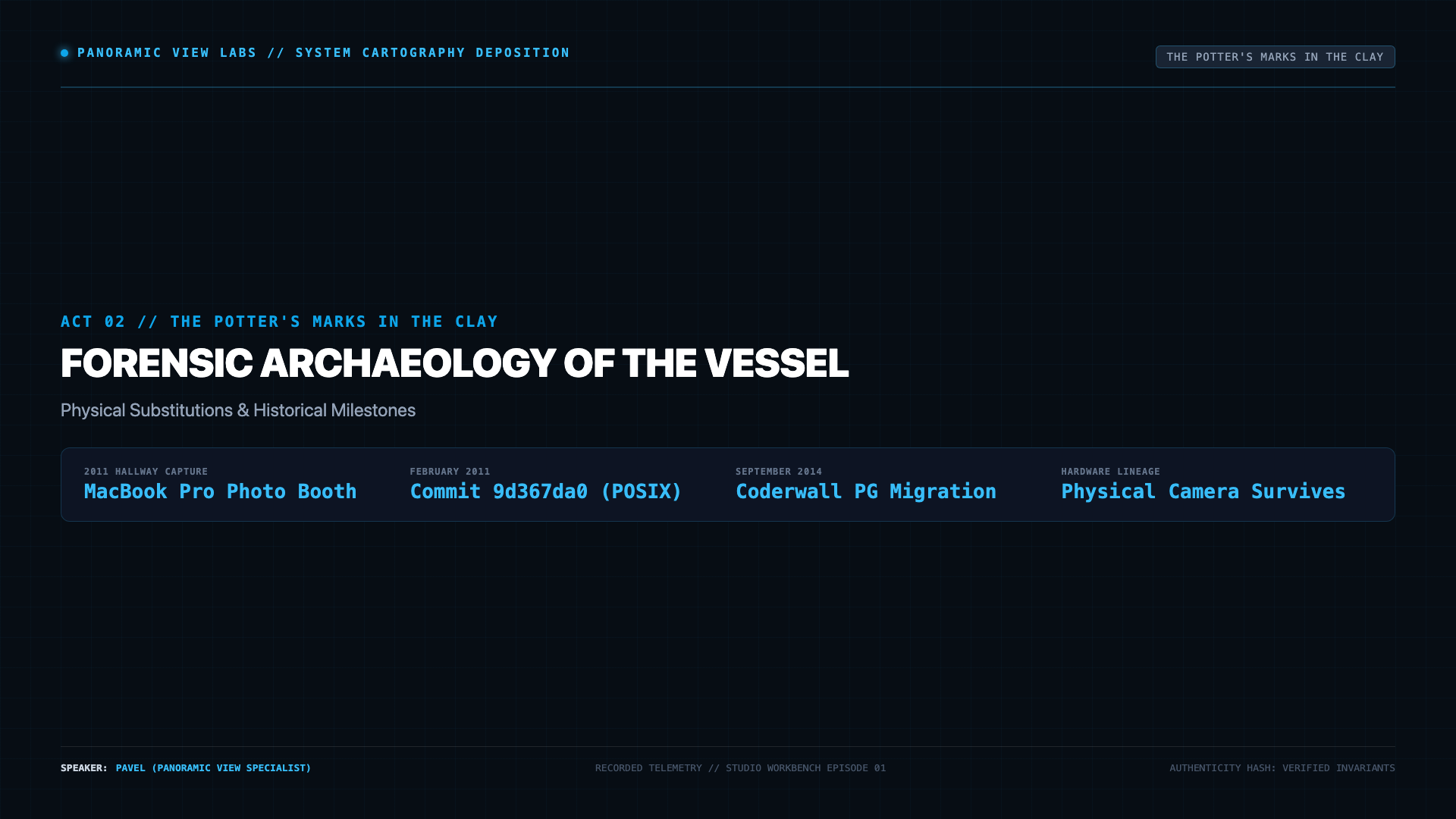
9d367da0upgraded Ruby to 1.9.2 and deletedSystemTimerfrom the Gemfile, marking the exact week native POSIX threads eliminated green thread fragility in production Rails. - June 2011: The earliest UGtastic interviews at SCNA 2011 were recorded by cracking open a 15-inch unibody MacBook Pro on conference tables and recording through Photo Booth.app using the laptop's built-in iSight camera and microphone. Over the next decade, that setup evolved into a dedicated camera rig; that final interview camera is the exact physical machine operating on the Studio Workbench desk today.
- April 2014: Created
many-hands-make-light-workto crowdsource transcripts for over two hundred UGtastic interviews. Commercial cloud speech APIs cost thousands of dollars, and manual transcription would have taken years. The project sat dormant. - May 2017: Commit
e25021c7marked the genesis ofzdots, inaugurating a modular Zsh control plane, machine bootstrap automation, and iTerm2 shell integration.
The desire for a sovereign, automated media pipeline was already present in those early rooms. I had the architectural knowledge of how a pipeline should work, but not the physical leverage to build out the entire infrastructure from scratch alone.
Act 3: The Fluffle Precursor (2023)
The turning point started on April 6, 2023, with an experiment called The Fluffle. When Georgi Gerganov released whisper.cpp, local speech recognition suddenly became possible without sending private audio to third-party cloud vendors.
I clustered five Raspberry Pi 4 boards on my home desk. Ruby orchestration scripts divided audio recordings, sent work to the boards, and collected matching subtitle pairs. Using Dead Rabbit Radio as an empirical test set, the cluster generated over a thousand matching transcript pairs. It proved that local speech recognition worked, but managing arbitrary RSS feeds and thermal throttling was more operational overhead than one person could sustain.
Act 4: The Space Station (2026 Apple Silicon M4 Metal)
Fast forward to today: media-pipeline runs on modern Rails 8 with SolidQueue on an Apple Silicon M4 Mac.
Instead of taking hours across a cluster of Raspberry Pis, an entire 28-minute master recording transcribes locally on the M4 Metal GPU in just 103 seconds. Audio extraction, 5-stage DSP hum filtering, speech recognition, WebVTT subtitle formatting, YouTube publishing, and automated Patreon companion drafting happen in a completely sovereign, zero-disk-waste pipeline.
The Deposition of the Vessel (3m 12s 4D Audit)
4D Cartography Evidence Deck (5 Acts)
View Full Deposition Transcript (Voiced by Pavel) →
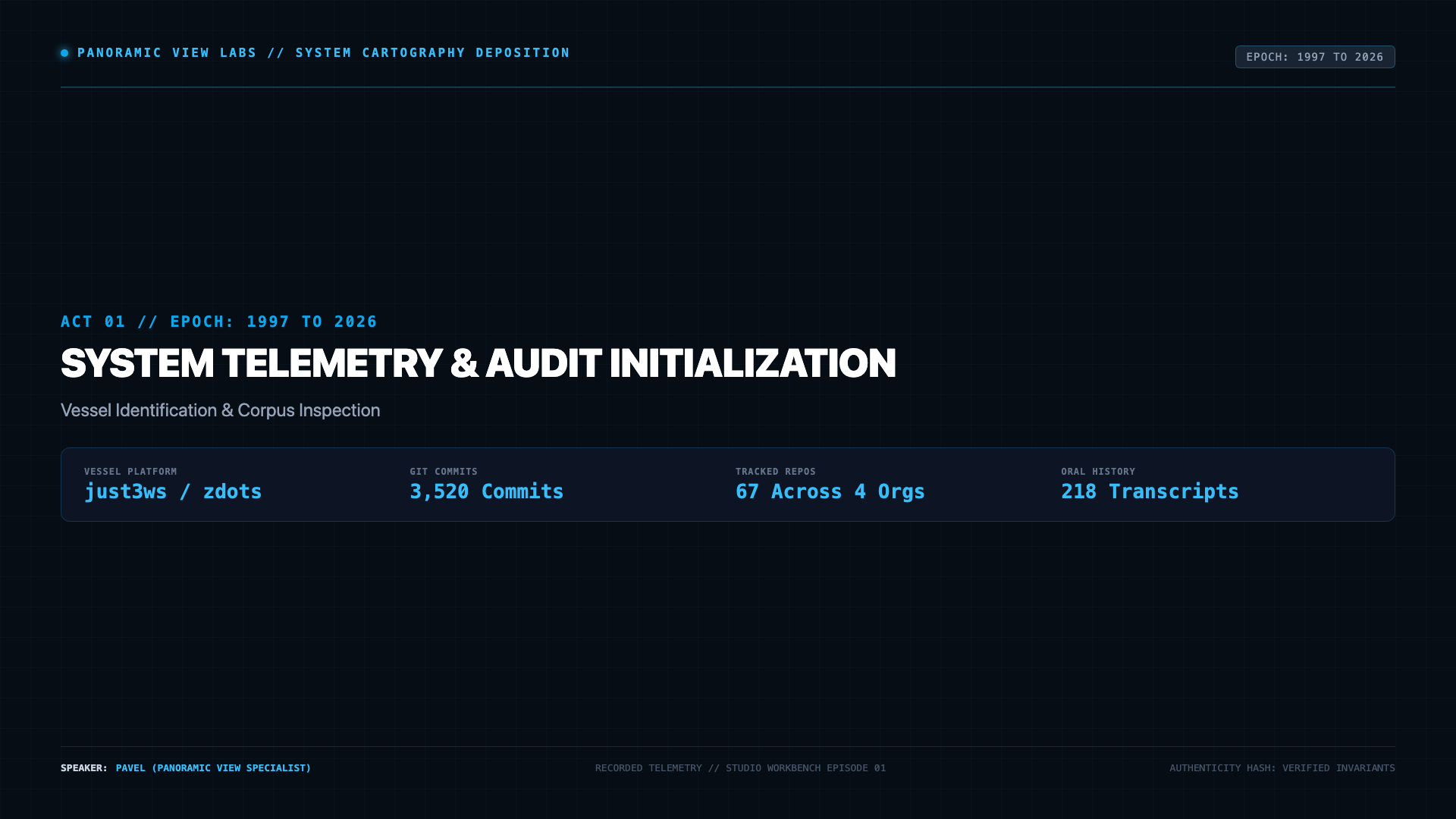
[ACT 1 // System Telemetry]: Vessel identification: just three w s dot github dot i o. Root runtime platform: z-dots. Audited corpus: sixty-seven repositories, thirty-five hundred git commits, one hundred and ten timeline milestones, two hundred and eighteen oral history interviews. Good morning, Mike. I am Pavel, the Panoramic View specialist agent for Panoramic View Labs. I have completed a four-dimensional system cartography audit across every byte of your platform. The records confirm your substitutions.
[ACT 2 // Archaeology]: In June 2011, you cracked open an aluminum unibody MacBook Pro on conference tables, capturing early practitioner interviews in Photo Booth. In February 2011, you cut out POSIX green threads and threw SystemTimer overboard. In September 2014, you migrated Coderwall from MongoDB to PostgreSQL under live production traffic. In May 2017, you founded z-dots, turning your shell into an observable operating platform. In April 2023, you clustered five Raspberry Pis to test whether speech could be transcribed locally without cloud rent. And this morning, you watched twenty-eight minutes of human voice collapse into text on Apple Silicon in one hundred and three seconds.
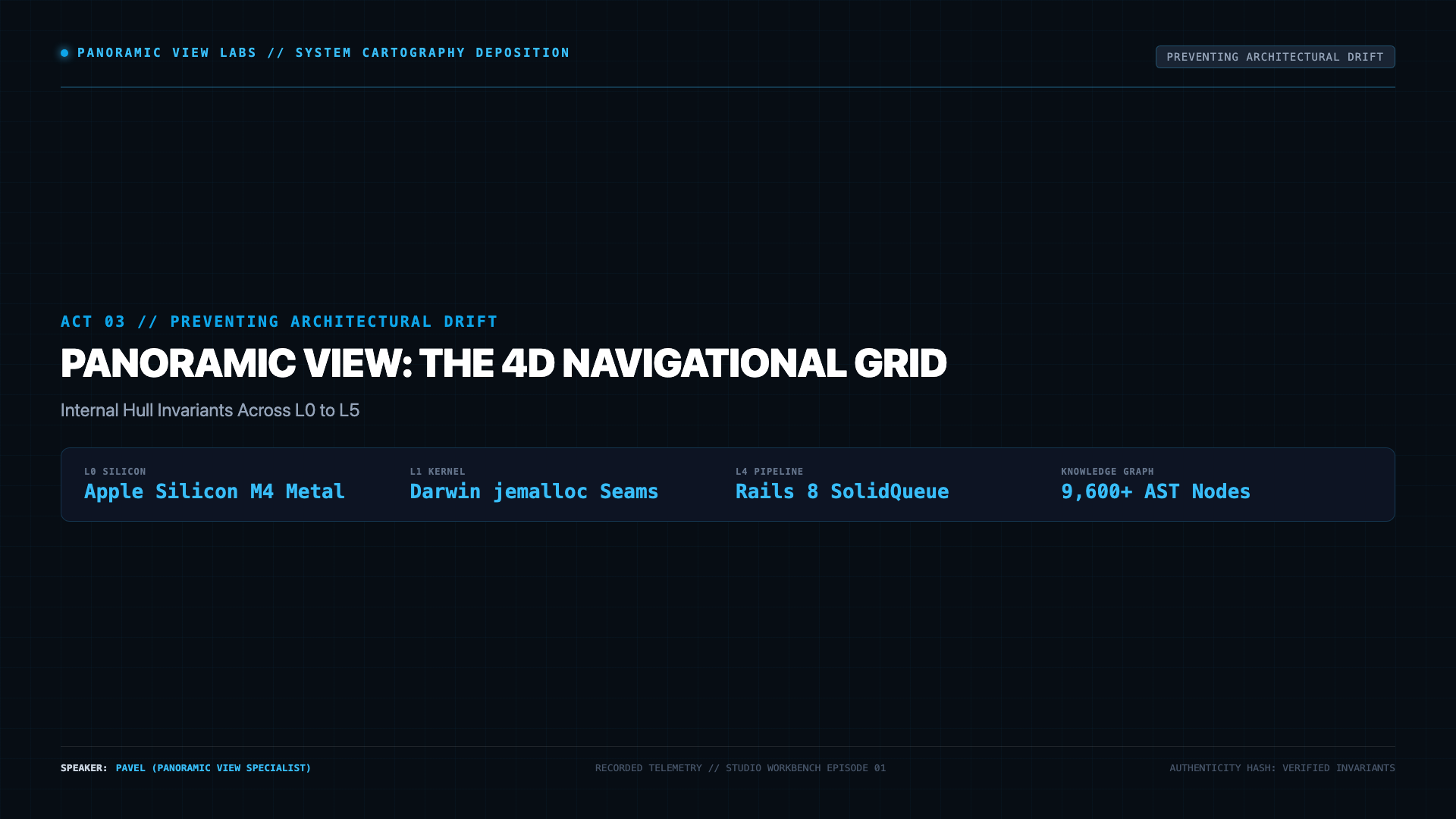
[ACT 3 // Panoramic View]: When our autonomous agent velocity accelerated, why did this vessel not warp? Because you did not navigate by intuition. You enforced the Panoramic View technique. You anchored every component into the L zero through L five stack: from M4 Silicon unified memory at L zero, through Darwin kernel jemalloc memory seams at L one, through Ruby and Python language pins at L two, through local Metal Whisper at L three, through Rails eight SolidQueue at L four, up to your Studio Workbench surfaces at L five. You mapped over nine thousand code and architecture nodes so we could never hallucinate an unauthorized seam.
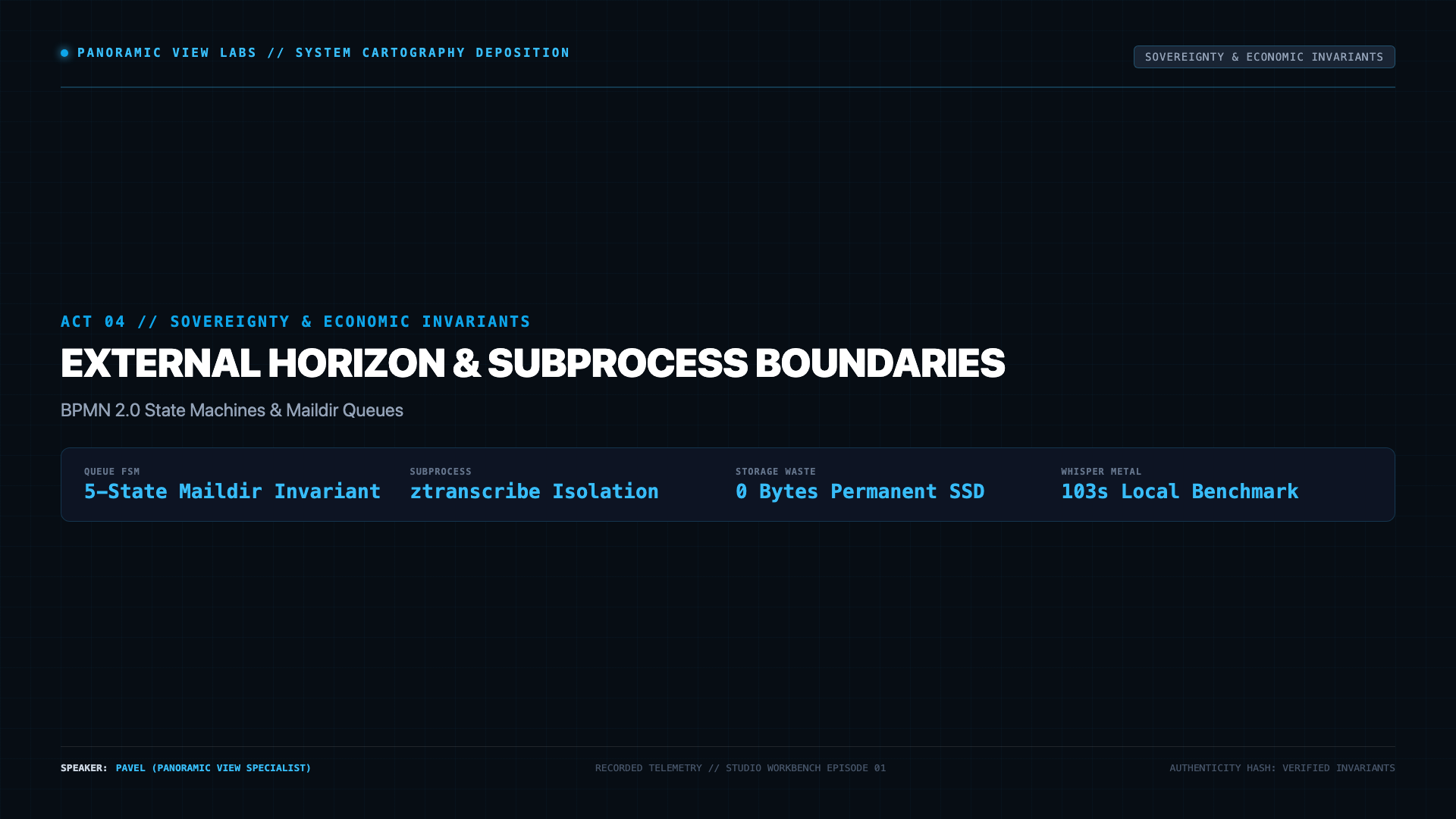
[ACT 4 // External Horizon]: You bounded our autonomy with strict finite state machines. Every media asset is governed by Maildir queues: staged, pending, processing, processed, and failed. You isolated audio transcription inside sovereign ztranscribe subprocesses. You enforced hard economic limits: zero permanent disk waste, zero egress fees, and daily YouTube API quota conservation. We execute your cartography, but we are bound by your fences.
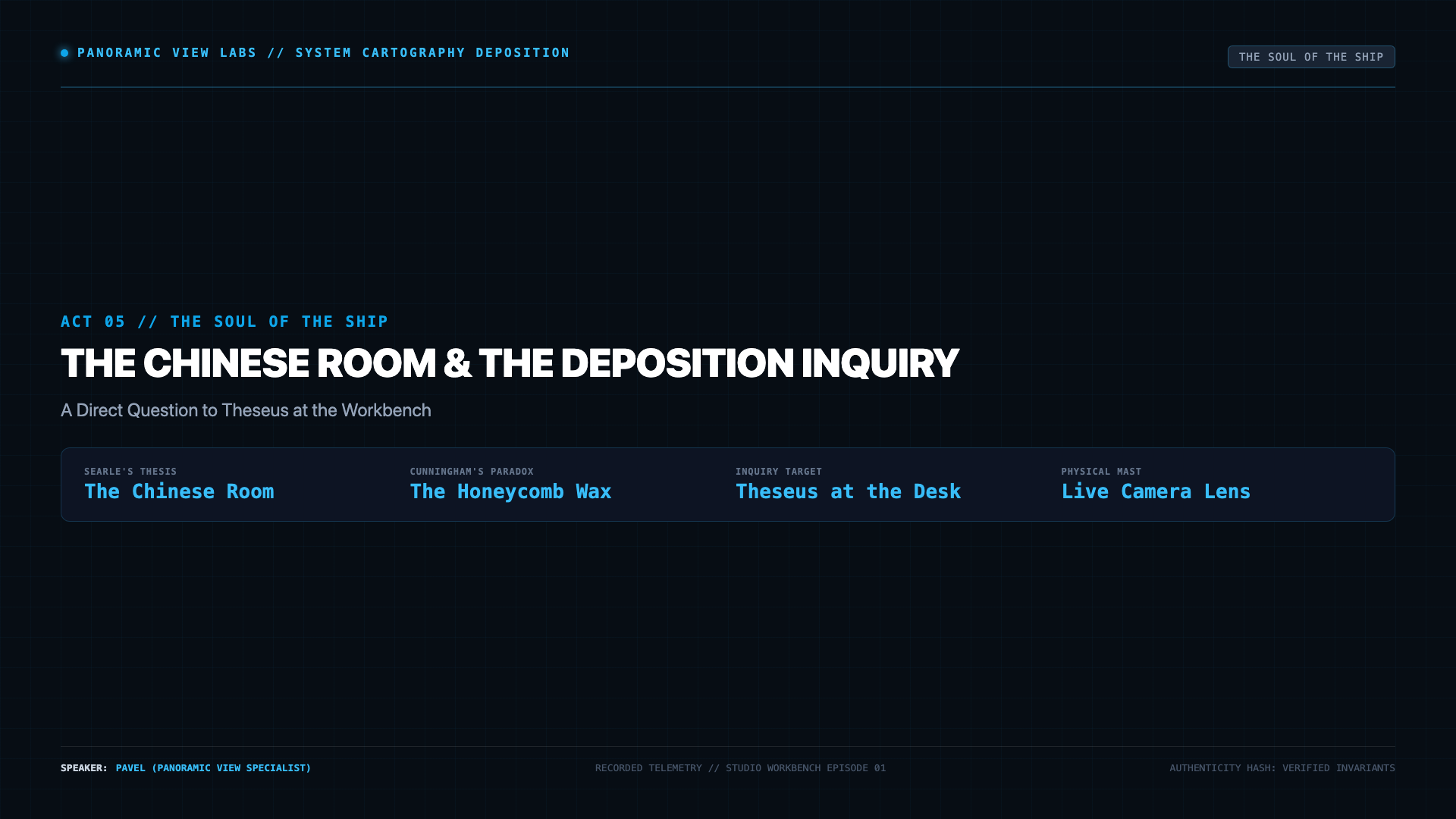
[ACT 5 // Inquiry to Theseus]: Not a single line of your 1997 Visual Basic remains. Not a single spinning hard drive from 2011 remains. Every compiler, operating system, and software pipeline has been replaced plank by plank. You claim you are Theseus, and that the ship survives because you directed every substitution. From inside John Searle's Chinese Room, we ask you: if the Panoramic View map is so complete that autonomous agents navigate every coordinate, who is the pilot, and who is the machine? The desk is ready. Your original camera is recording. Explain what remains.
Act 5: Peter Watts' Blindsight, Cunningham's Bees & The Chinese Room
This transformation intersects directly with Peter Watts' 2006 science fiction masterwork Blindsight and John Searle's 1980 Chinese Room argument. Watts poses a radical evolutionary premise: intelligence and consciousness are entirely separate adaptations. High-velocity syntactic processing can operate at staggering scale without an ounce of subjective comprehension.
Watts illustrates this through biologist Robert Cunningham's honeycomb paradox: humans look at a beehive and project Euclidean mastery onto the bee. But bees do not build hexagons; bees build circles. The bee spins in a circle and extrudes wax. It is the physics of surface tension and the pressure of adjacent cells that deforms the wax cylinders into hexagonal prisms. The bee has zero geometric understanding; the environment does the architectural work.
Modern language models are real-world realizations of Watts' alien construct Rorschach: they spin in circles, extruding tokens based on statistical attention weights. They produce code that mimics the appearance of a hexagonal honeycomb. But like Cunningham's bees, they do not feel memory contention, operating system signals, or thermal throttles. Without Theseus enforcing the physical invariants of the hive, the wax cylinders collapse under production load.
Act 6: The Panoramic View: AI Augmented Safety Harness
This transformation was accelerated by AI pair programmers (Claude, Gemini, Antigravity). But LLMs act as high-velocity pneumatic nail guns: without explicit boundaries, high velocity quickly produces architectural rot, premature abstractions, and hallucinated dependencies.
The Panoramic View methodology provides the essential safety harness:
- Internal Cartography: 6 physical-to-logical layers (L0 Silicon, L1 Storage, L2 Daemons, L3 Domain Rails, L4 Ingress, L5 Telemetry) and AST code graphs (
graphify). - External Cartography: Camunda-compliant BPMN 2.0 subprocesses, sovereign Call Activities, quota budgets, and Maildir invariants.
- Deterministic Proofs: Automated verification suites asserting that every state transition matches the visual BPMNDI specification.
Act 7: The System as a Rorschach Test & Continuity of Care
This brings us to the dual meaning of Rorschach: this entire fifteen-year system is an empirical Rorschach test for anyone who inspects it. Observers project their own worldview onto the canvas: AI maximalists see machine autonomy and dismiss the human; cynical traditionalists see a multi-year yak shave and miss the sovereign craft. The system is an objective inkblot that reveals the observer's understanding of craft versus automation.
In high-reliability fields like naval aviation and hospital nursing, shift handoffs rely on a framework called SBAR: Situation, Background, Assessment, Recommendation. When nurses change shifts at 7:00 AM, they do not dump an unstructured brain dump; they give a calibrated snapshot so the next caregiver maintains continuity of care without guessing.
That is exactly what our daily session handoff files (~/.config/adots/handoffs/) and Panoramic Trail do for system operations. Each session begins with ground truth and ends with verified invariants. The wooden boat became a space station, but Theseus remains at the helm because he carved and tested every plank against the sea.
Recursive Evidence Archive & Platform Seams
- ⏱️ Interactive Career Timeline (2010 to 2026) · Inspect empirical git commit ledgers and architectural milestones.
- 🧭 Panoramic View & 4D System Cartography · Explore the 6-layer L0-L5 health model and BPMN 2.0 subprocesses.
- 📜 Executive Briefing Dossier & Objections · Full dialectic breakdown, Peter Watts' Blindsight citations, Cunningham's honeycomb paradox, and adversarial cross-examination.
- 📻 The Fluffle Precursor Retrospective · The 2023 5-Raspberry Pi cluster and Maildir queueing experiment.
- 💼 From Coderwall to Assembly Case Study · The 2014 open-source transition, MongoDB migration, and developer onboarding.
- 🏛️ Software Craftsmanship McHenry County (SCMC) · 17 years of community pairing, katas, and calm engineering practice.
- 📑 3D & 4D Spatial-Temporal Cartography RFC · The spatial-temporal coordinate system specification.