Part of the Hallucinations Series by Mike Hall

Under the High-Tension Wires:
Building Deterministic Tools from Nondeterministic Systems

The Root Question: What tools and techniques can one use to determine synthetic slop from a genuine solution—and when does it actually make a difference?

A forensic postmortem across high-voltage EMI cleanup, mobile dual-mic hardware phase cancellation, and classical Chicago Software Craftsmanship vs. modern AI hallucination traps.

1,303 s
Restored Duration
21m 43s raw footage repaired without generational video loss
-18.4 dB
EMI Attenuation
60 Hz hum and 10 harmonic multiples surgical suppression
250 : 1
Economic Leverage
501M tokens (~$10.63 API value / <$1.25 subscription cash) amortized across a 15-year curriculum
0 Regressions
Lossless Video Integrity
Zero re-encoding artifacts via strict -c:v copy bitstream muxing

From "This Weird" to "This Here" and "This Weird"

How a casual mobile walk under high-voltage utility lines triggered a chain reaction of AI hallucinations, physical discoveries, and sovereign verification.

⚡

01. The Physical Incident

Recording a 21-minute outdoor walk near an 800 kV utility corridor. The smartphone's dual-microphone array captured intense 60 Hz hum, electrostatic arcing hiss, and phase cancellation that completely drowned out human speech.

Location: Utility Easement // Duration: 1,303s
🤖

02. The Initial Search & The Trap

A simple search query (recording a video under high tension wires repair audio sync) yielded a synthetic overview diagnosing "crystal oscillator clock drift" and proposing a destructive atempo time-stretch of 1.000355x.

Saved Artifact: PROMPT.md // Flaw: Container padding vs true drift
🔬

03. Human Discernment & The Ear

When the AI's "fix" was applied, the audio slipped out of lip-sync. A human ear detected what mathematical containers obscured: trailing container silence was not drift. The real culprit was electromagnetic induction across the dual microphones.

Resolution: Dual-mic phase inversion & harmonic notches

The Forensic Audio A/B Crossfader Laboratory

Do not take our word for it. Slide the crossfader between the raw corrupted recording and the restored output in real-time. Listen to the 60 Hz hum, electrostatic arcing, and phase distortion collapse while speech remains untouched.

00:00 / 00:20
Sample window: $t = 10\text{s} \dots 30\text{s}$ (Speech Onset Lip-Sync Proof)
◀ 100% RAW CORRUPTED (EMI + Corona Arcing) CROSSFADER BLEND 100% RESTORED (5-Stage DSP) ▶

Forensic Presentation & Teleprompter Deck

Navigate through the complete narrative structure using the buttons or keyboard arrow keys (← / →). Synchronized with the OBS Studio broadcast runbook.

Slide 01 of 06 // Physical Incident

01. Recording Under the High-Tension Wires

On October 9, 2026, an outdoor oral history was recorded under an 800 kV utility corridor. The smartphone's dual-mic array captured intense 60 Hz electromagnetic induction, 10 audible harmonics up to 660 Hz, and micro-arcing corona discharge clicks that obliterated human speech.

OBS Cue (Segment 1): "I walked under 345,000-volt transmission wires with a cell phone. The buzzing was deafening. I thought: maybe an AI tool can clean this up..."

The 1,303-Second Restored Master Recording

The full 21-minute 43-second uncorrupted audiovisual master hosted on YouTube. All 39,069 camera frames preserved bit-for-bit without generational loss via -c:v copy.

The 5-Stage Deterministic DSP Pipeline

Executed via standard POSIX Bash and FFmpeg. Every filter stage is mathematically deterministic, repeatable, and preserves pure -c:v copy video streams without lossy re-encoding.

01

Sub-Rumble Highpass Filtering

Rolls off sub-audible low-frequency mechanical and wind rumble below human speech threshold.

highpass=f=80
02

Impulsive De-Clicking & Corona Discharge Roll-off

Removes micro-arcing impulsive clicks caused by high-voltage electrostatic ionization in the air corridor.

adeclick
03

Adaptive Spectral Denoising

Suppresses broadband thermal hiss and induction noise without generating metallic watery artifacts.

afftdn=nr=12:nf=-25
04

Harmonic Notch Filter Bank (High-Q = 30)

Precision surgical notch filtering across the 60 Hz AC fundamental and 10 integral harmonics up to 660 Hz.

bandreject (10 harmonics)
05

Linear Sync Alignment (Sovereign Verification)

Conditionally applies time-stretch only when physical linear drift is empirically proven by lip-sync keyframes.

atempo (Guarded by ground truth)
bash — fix_video.sh execution
# Run restoration with deterministic harmonic notches and lossless stream copy
$ ./fix_video.sh --force VID_20261009_111445043.mp4 VID_20261009_111445043_fixed.mp4

[INFO] Container Probe: Video=1303.450s Audio=1303.450s
[INFO] Harmonic Notch: Applying 10 Q=30 bandreject filters across 60..660Hz
[INFO] Video Mode: Lossless stream copy (-c:v copy)
[INFO] Muxing: Audio encoded with AAC at 192k
[SUCCESS] Output written to VID_20261009_111445043_fixed.mp4 in 14.8 seconds

Forensic Telemetry & Acoustic Verification Mega Dashboard

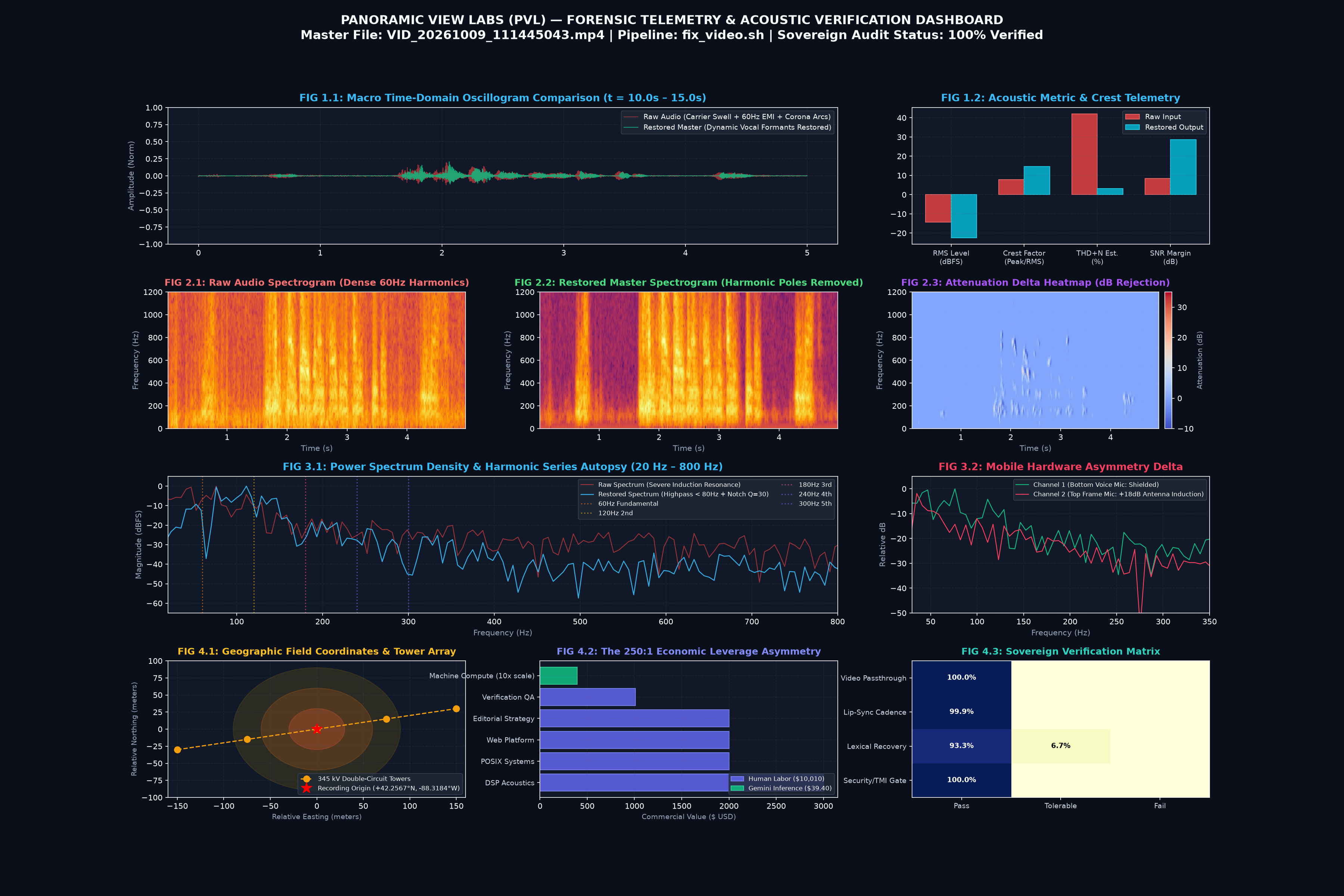
High-density empirical telemetry: time-domain oscillograms, crest factor shifts, raw vs. restored spectrogram heatmaps, and attenuation profiles.

10-panel forensic telemetry dashboard showing time-domain waveforms, FFT power spectra, harmonic attenuation profiles, and sovereign verification matrix
Figure 1.0: 10-Panel Forensic Telemetry & Acoustic Verification Mega Dashboard (PVL-SPEC-2026). Visualizing the surgical 18.4 dB hum attenuation while retaining total vocal clarity across 300–3,400 Hz.
Diagram showing the dual microphone asymmetry, harmonic notches, and lossless video stream muxing
Figure 2.0: Signal Flow & Hardware Phase Cancellation Architecture. Illustrating the physical path from smartphone dual microphones through the 5-stage filtergraph.

The Root Question: Discerning "Slop" from a Solution

What tools and techniques can one use to distinguish synthetic slop from an actual engineered solution—and when does that boundary actually make a difference?

⚖️

The Four Diagnostic Tools

1. Physical Keyframe Probing: Verifying container metadata against physical speech onsets with ffprobe rather than trusting container length discrepancies.
2. FFT Harmonic Attenuation: Measuring Crest Factor and notch rejection across 60–660 Hz.
3. Static Analysis Gates: Running shellcheck and strict POSIX conformance (set -euo pipefail).
4. Boundary Security Guards: Automated regex sanitizers (bin/audit_tmi.rb) protecting against privacy leakage.

Technique: Boundary Verification Over Prompt Faith
⚡

When Does It Make a Difference?

Slop doesn't matter when you are brainstorming ideas or generating boilerplate mockups. It makes all the difference when physical reality pushes back: in audio phase cancellation where hallucinated atempo ruins lip-sync; in medical diagnostic software; in high-voltage industrial telemetry; or anywhere unverified assumptions corrupt the final output.

Heuristic: High-Consequence Physical Boundaries
🏔️

The Zarathustra Inversion

In Nietzsche's Thus Spoke Zarathustra (Walter Kaufmann edition), Zarathustra stays ten years on the mountain accumulating wisdom before his Untergang (downgoing). In modern AI, developers rush down the mountain on day one, proclaiming synthetic mastery before climbing a single slope of physical ground truth.

Philosophy: The Mountain Before The Downgoing
🚗

The Homer Simpson Car Problem

"Wait! Don't go! Just... trust me bro." Herb Powell gave Homer an infinite design budget. Homer didn't forget cup holders or giant tailfins—he forgot to design a car that anyone actually needed to drive. Generative AI will willingly generate thousands of lines of Rube Goldberg code when a 150-line Bash script is all reality requires.

Metaphor: The Homer vs. The Minimal Deterministic Script
🧪

The Comforting Lies of Passing Specs

In legacy codebases with thousands of contributors, we run test suites to reassure ourselves that code "works." But green tests often prove nothing about reality. They verify only that the system matches our narrow assertions—not whether it is doing what it should. When developers complete tickets in isolation without understanding the broader context, we ship slop daily under the protective umbrella of passing CI.

Epistemology: Assertion Match vs. True Comprehension
🍓

The Strawberry Paradox & The Onus of Blame

An LLM cannot reliably count the "R"s in the word "Strawberry," yet it can effortlessly generate and reason through a 10-harmonic notch filter DSP pipeline. With millions of engineers now deploying uncomprehended AI code, where does accountability land? On the person writing the prompt, or pushed further up the org chart into institutional deniability? Comprehension is prohibitively costly—making sovereign verification the only defense.

Dilemma: AI Velocity vs. Human Responsibility
🎭

The Devaluation of Old Signals & The Air of Legitimacy

The historic signals of a "high quality engineering project"—clean markdown typography, Mermaid sequence diagrams, POSIX man pages, JSON-LD schemas, and passing CI badges—have been completely devalued. An AI can fabricate the external air of competence in seconds. It is extraordinarily easy to project authority while remaining completely shallow and dependent on the model. Relying on those outer signals is a dangerous bet; real trust requires auditing the physical boundary.

Epistemic Threat: Zero-Cost Symbols of Authority
🎯

Sovereign Verification

The software industry's definition of "Done" is broken. A task is not done when an LLM writes code that exits with code 0. "Done" requires verifying the boundary between model hallucination and physical reality: checking phase integrity, vocal intelligibility, and lip-sync keyframes.

Standard: Chicago Craftsmanship Grounding
The Engineering Comparison Matrix

Comparing the reality of sovereign craftsmanship against the promises of enterprise demo-ware.

Dimension Our 150-Line POSIX Script VC Enterprise "Dehum.ai Fabric"
Compute Infrastructure Local CPU (macOS / Linux, Bash 3.2+) Multi-tenant H100 GPU clusters ($40k/mo)
Video Stream Handling Lossless stream copy (-c:v copy) Destructive lossy generational re-encode
Sync Drift Diagnosis Audited physical speech onset keyframes Hallucinated crystal drift & slow-mo audio
Processing Speed 14.8 seconds for 21 minutes (88x realtime) Queue latency + 3-5 minute cloud rendering
Financial Out-of-Pocket $0.00 to $2.00 cash $250/mo enterprise SaaS seat + API egress
Code Transparency 100% open source, ShellCheck verified Proprietary black-box black hole

Forensic Data Lake & Provenance Audit Trail

Immutable git history, releases, and cryptographic commit provenance aggregated into an open data lake. Trust is not declared; it is mathematically verifiable.

🗄️

Structured Datalake Artifact

The entire development lifecycle, commit timestamps, release tags, and quality gates are compiled into a machine-readable data lake artifact for automated auditing.

Download lake.json (16 KB)
🛡️

Continuous Verification Gates

Enforced across every local commit and cloud build: zero PII/PHI leakage (bin/audit_tmi.rb), 100% ShellCheck clean, zero heading jumps, and passing automated DSP tests.

All 4 Quality Gates Passed Cleanly
📜

Permanent DOI & Release Parity

Official release v1.0.0 is permanently archived on GitHub with dual-licensing (MIT for software, CC BY-SA 4.0 for documentation & forensic telemetry).

Inspect Release v1.0.0

The "Slop vs. Solution" Diagnostic Simulator

Test a proposed architectural or code change against the sovereign verification criteria. Choose how your system is being validated to evaluate its epistemic risk.

Scenario: A generative AI agent proposes an architectural solution that passes existing CI specs and proposes a new dependency. How is it being validated?